Category: Field Notes

  • The Spider and the Onion

    The Spider and the Onion

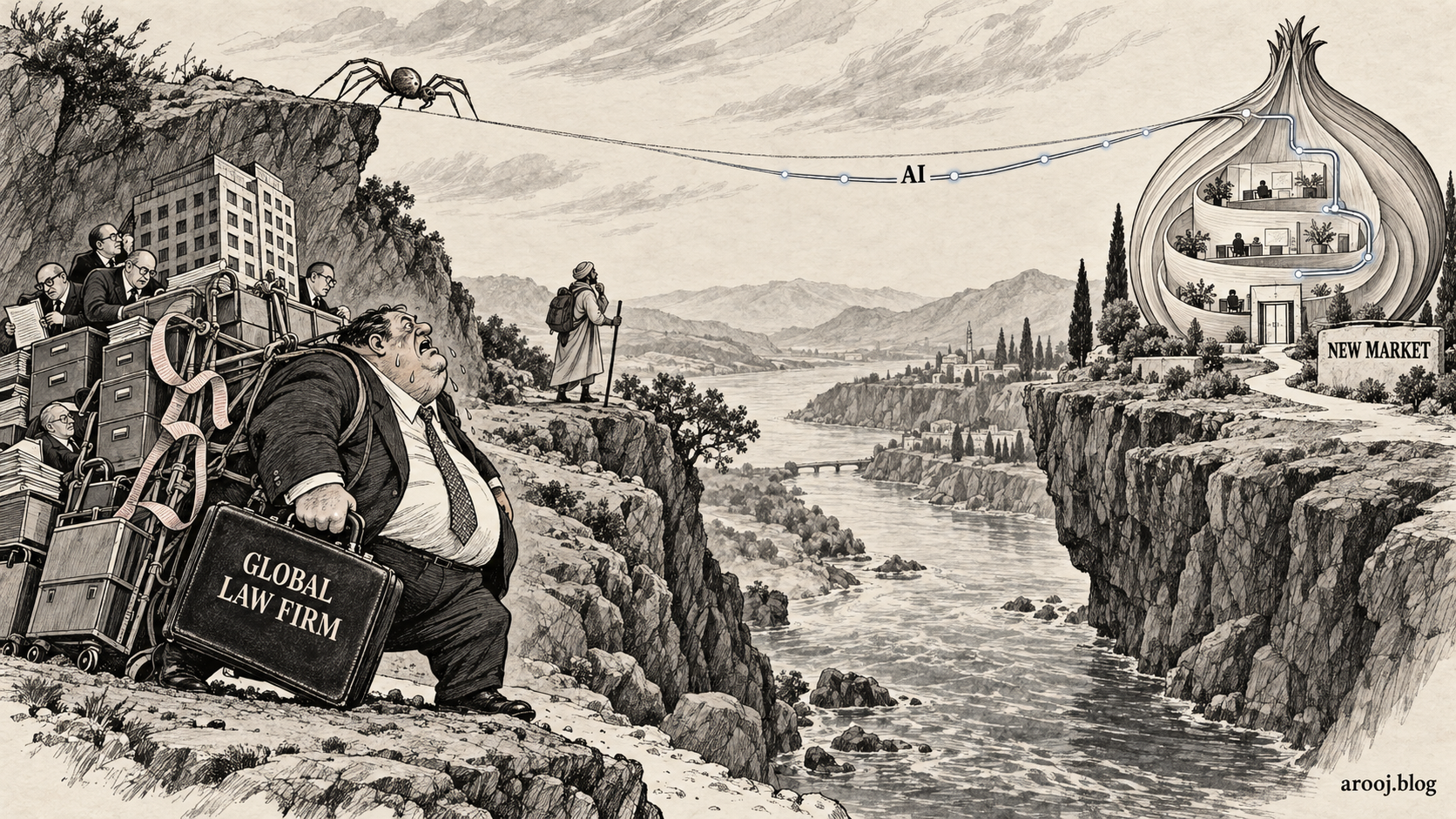
    The spider does not carry a bridge. It fires a thread into the wind and lets the wind take it farther than its own body could.
    Once the thread catches, the spider tests it and sprints across.
    Now the onion.
    It has no grand centre pretending to be the whole.
    Layer sits upon layer until the layers themselves become the onion.

    International law firms?
    They are bureaucratically obese — taking years to enter a market, longer to settle inside it, and then operating under enormous drag.
    The Qur’an tells us to travel through the earth and observe the workings of Allah’s creation.
    We use the spider’s method to enter — a thin thread, launched from strength and carried by existing currents.
    We use the onion’s method to take root — one functional layer, then another, until a real firm exists without the dead weight of a miniature empire.
    Wire AI across the two and the experiment becomes a system. The spider gives us reach. The onion gives us form. AI institutionalises the method.
  • Open Chambers

    Open Chambers

    A law firm used to be a place.

    An office. A library. Partners behind doors. Associates down the corridor. Clients came to the lawyers because the lawyers, the files and the knowledge were all in one building.

    That is changing.

    A client can now have one problem touching three jurisdictions, four lawyers and two time zones before lunch.

    The challenge is no longer proximity.

    It is coordination.

    A real global firm is not a directory of lawyers scattered across countries. It needs one memory, one standard and clear responsibility for the work moving through it.

    Software helps.

    Deadlines stop living in someone’s head. Research becomes searchable. Documents carry histories. Knowledge survives the person who created it.

    But geography becoming loose makes discipline more important, not less.

    Who owns the matter?

    Who checks the work?

    Who is licensed to do what?

    Who answers when something breaks?

    The office was once the container.

    It does not have to be anymore.

    The old law firm put walls around its lawyers.

    The next one will put walls around the work.

  • Legal Convexity

    Legal Convexity

    I was working with a client when I first smelt the rot. The fellow was doing everything by the book — compliance neat, disclosures proper, mandates clean — yet money leaked from him like water through a cracked pipe. Traders blamed volatility. Lawyers blamed the market. Both were wrong.

    The bug, I suspected, sat somewhere between law and execution. Lawyers understand procedural sequencing, settlement mechanics, custodial onboarding, regulatory triggers, administrative exhaustion. Traders understand price discovery, liquidity and momentum.

    But neither understands the other’s jungle.

    And in that wilderness lies money.

    So I began digging. Twenty-seven days. More than two hundred models. Each one collapsed like a badly stitched tent in a storm. Yet every failure strengthened the suspicion.

    Then on the twenty-eighth day, sometime past midnight, the screen confessed. There was indeed a bug. Not in price, but in permission. A lag between public regulatory clarity and institutional deployability.

    ETF approvals, sanctions shifts, custody authorisations, bankruptcy rulings, index inclusions — the market heard the news immediately, but the institutions could not move.

    Compliance committees had to meet. Custodians had to approve. Mandates had to unlock. Capital sat paralysed in conference rooms while reality had already changed outside.

    Two days later the code was ready. And yes, the thing could be exploited.

    So here’s to mandate-constrained flow lag, committee-cycle drag, settlement-finality friction and custody activation latency. Let others trade headlines like excitable schoolboys.

    We shall trade delayed institutional permissioning.

    The trouble with law is the same as the trouble with code. Once codified, it develops loopholes.

    And loopholes, like lonely widows, are eventually discovered by someone patient enough.

  • Launch Pressure

    Launch Pressure

    I spent part of this stretch refining how to present our attorney platform to the public. The platform already includes attorney infrastructure across all 50 U.S. states, onboarding systems, operations, security layers, and client intake flows, but the problem was explaining that clearly without sounding inflated or technical. The fix was to strip the message down to what people actually need to grasp — what it does, who it serves, and why the system behind it matters. One lesson kept returning — clarity is not decoration at the end of the work; it is part of the work itself.